


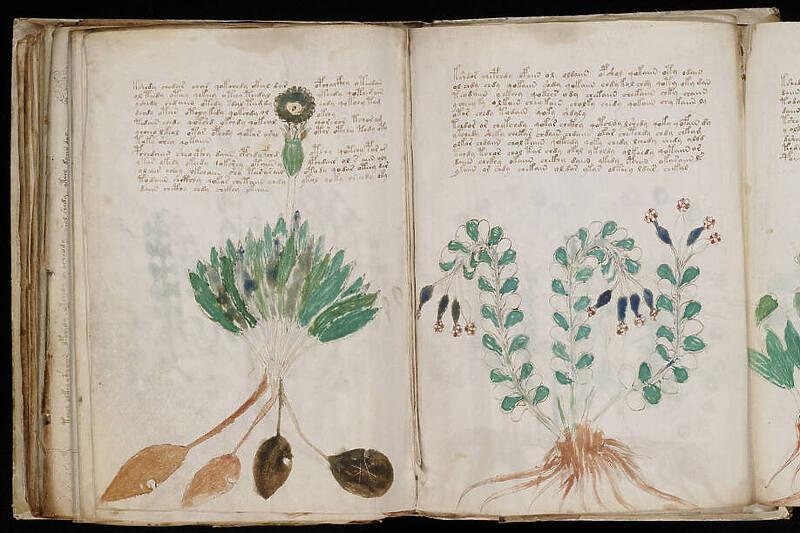
What if you discovered a book that nobody on Earth could read?

A Book That Refuses to Speak
Imagine walking into an ancient library and finding a mysterious book hidden among hundreds of old manuscripts.
You carefully open it.
Inside are pages filled with strange symbols, beautiful drawings of unfamiliar plants, mysterious circles and illustrations that seem to belong to another world.
The writing looks like a real language. Some words repeat. The letters follow unusual patterns. Whoever created it seems to have known exactly what they were doing.
There is just one problem.
Nobody knows what it says.
This is the Voynich Manuscript, one of the most fascinating mysteries in history.
For generations, historians, scientists and experts in secret codes have tried to understand it. Some believe it contains forgotten scientific or medical knowledge. Others suspect it might be written in a secret language.
And a few have even wondered whether the entire thing was designed to fool its readers.
More than six centuries after its parchment was made, the mystery remains unsolved.
The Discovery That Started a Mystery
In 1912, a bookseller named Wilfrid Voynich acquired a collection of old manuscripts from a Jesuit institution near Rome.
Among them was a particularly unusual book.
Its pages were covered in mysterious writing, accompanied by drawings of plants, stars and strange figures.
Voynich had never seen anything quite like it.
He began investigating its history, hoping to discover who had written it and what it meant.
But he soon realised something extraordinary.
He was not the first person to struggle with the book.
Documents showed that the manuscript had already puzzled scholars hundreds of years earlier.
During the seventeenth century, it was associated with people interested in languages, science and mysterious writings.
One of them was Athanasius Kircher, a famous scholar who studied ancient languages and writing systems.
In 1666, another scholar, Johannes Marcus Marci, sent the manuscript to Kircher, apparently hoping he could make sense of it.
No successful translation is known to have resulted.
The mystery was already centuries old when Voynich brought the book to wider attention.
What Is Hidden Inside?
The Voynich Manuscript is not an ordinary book.
Its surviving pages contain several different kinds of illustrations, each raising more questions than answers.
The mysterious plants
Many pages show plants with unusual roots, leaves and flowers.
Some resemble real plants, but others are difficult to identify. A few seem to combine features from different species.
Were these drawings intended to teach readers about medicine?
Were they descriptions of plants that existed in the author’s world?
Or were they symbolic illustrations with meanings we no longer understand?
Nobody can say for certain.
The stars and strange circles
Other pages contain circular diagrams, stars and symbols resembling those used in medieval astronomy and astrology.
Astronomy is the scientific study of objects in space, while astrology is a traditional belief system that connects celestial movements with human affairs.
The diagrams might relate to the stars, the calendar or medieval ideas about the universe.
But without understanding the writing, their precise purpose remains unknown.
The unusual figures
Some of the most puzzling illustrations show small human figures standing or bathing in pools of coloured liquid, connected by complicated tubes and channels.
Researchers have suggested several possible explanations, including medieval ideas about health and the human body.
However, these are interpretations rather than proven facts.
Whatever the drawings mean, they make the manuscript unlike almost any other surviving medieval book.
How Old Is the Manuscript?
For years, researchers wondered whether the manuscript was truly medieval or perhaps a clever forgery created much later.
Modern science helped answer part of that question.
Scientists examined the parchment, the material used for writing before paper became widespread in Europe.
Using a technique called radiocarbon dating, which estimates the age of once-living materials, researchers found that the parchment dated to approximately 1404–1438.
That places it in the early fifteenth century.
This was an important discovery.
It showed that the material used to make the book was genuinely old.
However, there is an important difference between dating the parchment and dating the writing.
Scientists can estimate when the animal skin used for the pages was produced, but that does not tell us the exact day or year when someone wrote on it.
Even so, the evidence strongly connects the manuscript to the medieval world.
Someone, hundreds of years ago, went to considerable effort to create it.
But who?
And why?
A Language Nobody Recognises
The greatest mystery is the writing itself.
Researchers often call the manuscript’s unusual script Voynichese.
At first glance, it looks like a language.
Certain symbols appear repeatedly, while others occur only in particular positions.
Some combinations are common. Others are extremely rare.
These patterns have fascinated linguists — people who study languages and how they work.
But no known language has been reliably identified as the one behind the text.
This has led to several theories.
Perhaps the manuscript contains a real language written using an unfamiliar alphabet.
Perhaps it uses a cipher, a system that hides a message by changing how letters or words are written.
Or perhaps the symbols were invented for another purpose entirely.
The difficulty is that nobody has produced a translation that other experts can independently confirm.
Many people have claimed to solve the manuscript.
So far, none of those proposed solutions has gained general acceptance among specialists.
Was It Written by More Than One Person?
For a long time, people imagined a single mysterious author sitting alone, carefully filling the pages with strange writing.
But recent research suggests the story may be more complicated.
Medieval manuscript specialist Lisa Fagin Davis has identified differences in the handwriting that suggest several scribes worked on the manuscript.
A scribe is someone who writes or copies documents by hand.
This is especially interesting because it raises a new question.
If several people wrote the manuscript, did they all understand the same mysterious writing system?
Perhaps they were working together.
Perhaps they belonged to a group that shared specialised knowledge.
Or perhaps different people simply helped produce the book, as they did with many medieval manuscripts.
We do not know which explanation is correct.
But the possibility of several writers makes the manuscript’s forgotten script even more intriguing.
Could Modern Technology Solve It?
Today, researchers have tools that medieval scholars could never have imagined.
Computers can examine thousands of symbols, compare patterns and search for similarities between languages.
Some researchers have also explored whether modern artificial intelligence could help analyse the manuscript.
These methods can reveal interesting patterns, but they cannot automatically tell us what the words mean.
Imagine receiving a message written in an unknown alphabet, with no dictionary, no translation and no clue about the language.
Even a powerful computer would struggle to determine what the message was trying to communicate.
That is essentially the challenge presented by the Voynich Manuscript.
Technology may eventually help solve the puzzle.
For now, however, its meaning remains uncertain.
Where Is the Book Today?
The Voynich Manuscript is now preserved at Yale University’s Beinecke Rare Book & Manuscript Library in the United States.
It is catalogued as MS 408.
The original is carefully protected because its pages are centuries old and cannot be handled like an ordinary modern book.
Fortunately, high-quality digital images are available to the public.
This means that anyone with an internet connection can examine its pages.
You do not have to be a historian, scientist or university professor to look at the mystery for yourself.
You can study the strange plants, inspect the mysterious writing and try to imagine what its creators intended.
Perhaps one day, someone will notice a detail that generations of researchers have overlooked.
The Secret That History Forgot
There is something remarkable about the Voynich Manuscript.
It has survived wars, political changes, the rise and fall of kingdoms, and more than six centuries of history.
The people who created it are long gone.
Their world has changed beyond recognition.
Yet their book remains.
We know roughly how old its parchment is.
We know some of the people who owned it.
We can examine its illustrations and count its mysterious symbols.
But we still cannot confidently explain what its pages are saying.
Perhaps it contains medical knowledge.
Perhaps it records unusual ideas about nature and the universe.
Perhaps its meaning is completely different from anything we have imagined.
Until someone finds convincing evidence, those possibilities must remain theories.
And that is what makes the Voynich Manuscript so fascinating.
History has preserved the book. But it has not preserved the key to understanding it.
Six centuries later, the pages are still waiting to tell their story.
Sources and Further Reading:
- Yale University, Beinecke Rare Book & Manuscript Library — The Voynich Manuscript (MS 408): https://beinecke.library.yale.edu/beinecke/collections/beinecke-cipher-voynich-manuscript
- Yale University — Digitised Voynich Manuscript (MS 408): https://collections.library.yale.edu/catalog/2002046
- Davis, Lisa Fagin (2020). How Many Glyphs and How Many Scribes? Digital Paleography and the Voynich Manuscript. Manuscript Studies, 5(1), 164–180.
- Zandbergen, René — The Voynich Manuscript: Origin and History: https://www.voynich.nu/origin.html
- Zandbergen, René — Radiocarbon Dating of the Voynich Manuscript: https://www.voynich.nu/extra/carbon.html
Leave a Reply